
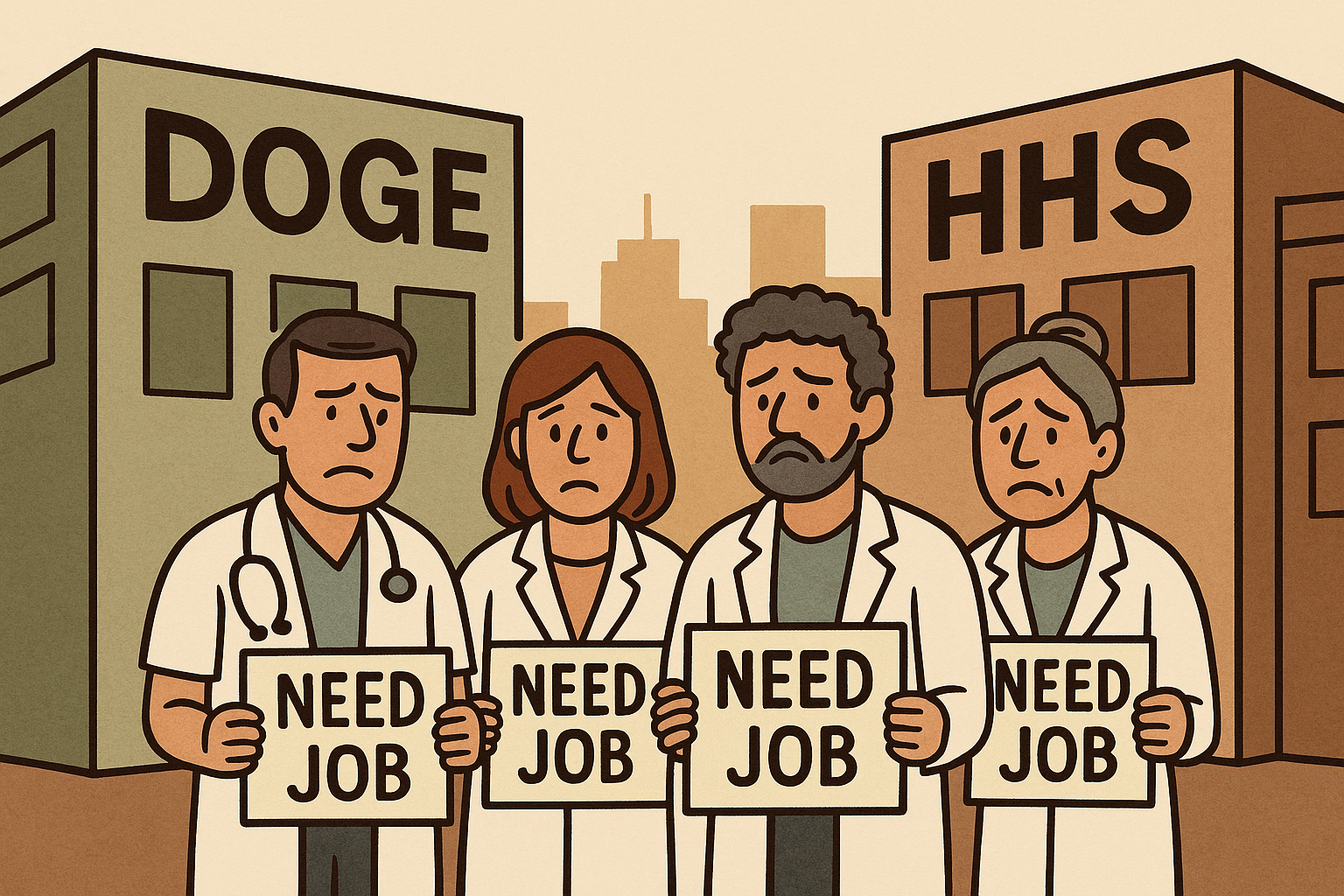
At the beginning of Donald Trump’s second term, the newly restructured Department of Government Efficiency (DOGE), initially led by billionaire Elon Musk, launched a sweeping campaign to reduce federal spending. One of the most severely impacted agencies has been the Department of Health and Human Services (HHS). In just eight months, DOGE’s cost-cutting measures have gutted HHS programs, leaving a trail of disrupted services, shuttered initiatives, and tens of thousands of displaced public health workers.
As of August 24, 2025, using data from the DOGE website, I found:
- 2,244 HHS contracts have been terminated, affecting 1,072 unique vendors, with $9.25 billion in “savings”.
- 1,984 HHS grants have been cut, impacting 557 recipients, totaling $14.61 billion in “savings”.
Together, these cuts amount to $23.86 billion in reduced funding for public health purposes.
How Many Jobs Were Lost?
Let’s estimate the human cost of these cuts:
- Average salary of a public health worker: $62,232
- I used the average salary of a postdoctoral researcher ($62,232) as a proxy for public health worker compensation. This is a reasonable benchmark given the research-intensive nature of many public health roles.
- Median job tenure: 3.6 years
- Estimated portion of savings that would have funded salaries: 60%
- I assumed that 60% of the total “savings” would have gone toward salaries. This estimate is based on my experience working in a soft-money research institution (note: I’m NOT employed by Vanderbilt), where approximately 60% of our salary is expected to be covered by grants and contracts
- Jobs eliminated =$23.86 billion × 60% / ( $62,232 × 3.6 years) ≈ 63,914
That’s nearly 64,000 public health jobs gone. With the U.S. public health workforce previously estimated at 239,000 workers, this means 26.7% of the workforce has been eliminated—a staggering reduction in a field critical to national wellbeing.
What This Means for America
Public health workers are the frontline defenders against disease outbreaks, environmental hazards, and health disparities. Losing over a quarter of this workforce will have devastating consequences:
- Community health programs will be scaled back or shut down.
- Emergency response capacity will be weakened.
- Health education and outreach will suffer.
And the damage doesn’t stop at healthcare. Thousands of professionals are now unemployed, struggling to support their families and repay student loans. For recent graduates in public health, the job market has collapsed, leaving them adrift after years of training.
The situation is further worsened by Trump’s Big Beautiful Bill, which slashes Medicaid funding. With fewer professionals and fewer resources, the U.S., already ranked near the bottom in health outcomes among developed nations, is poised to fall even further.
Final Thoughts
Efficiency should not come at the cost of lives and livelihoods. The DOGE cuts may look good on a balance sheet, but they represent a profound disinvestment in the health of the American people. If we continue down this path, the consequences will be felt not just in hospitals and clinics, but in every community across the country.


